
East Sussex, BN41
Portslade render on Mile Oak blockwork and harbour-side gables
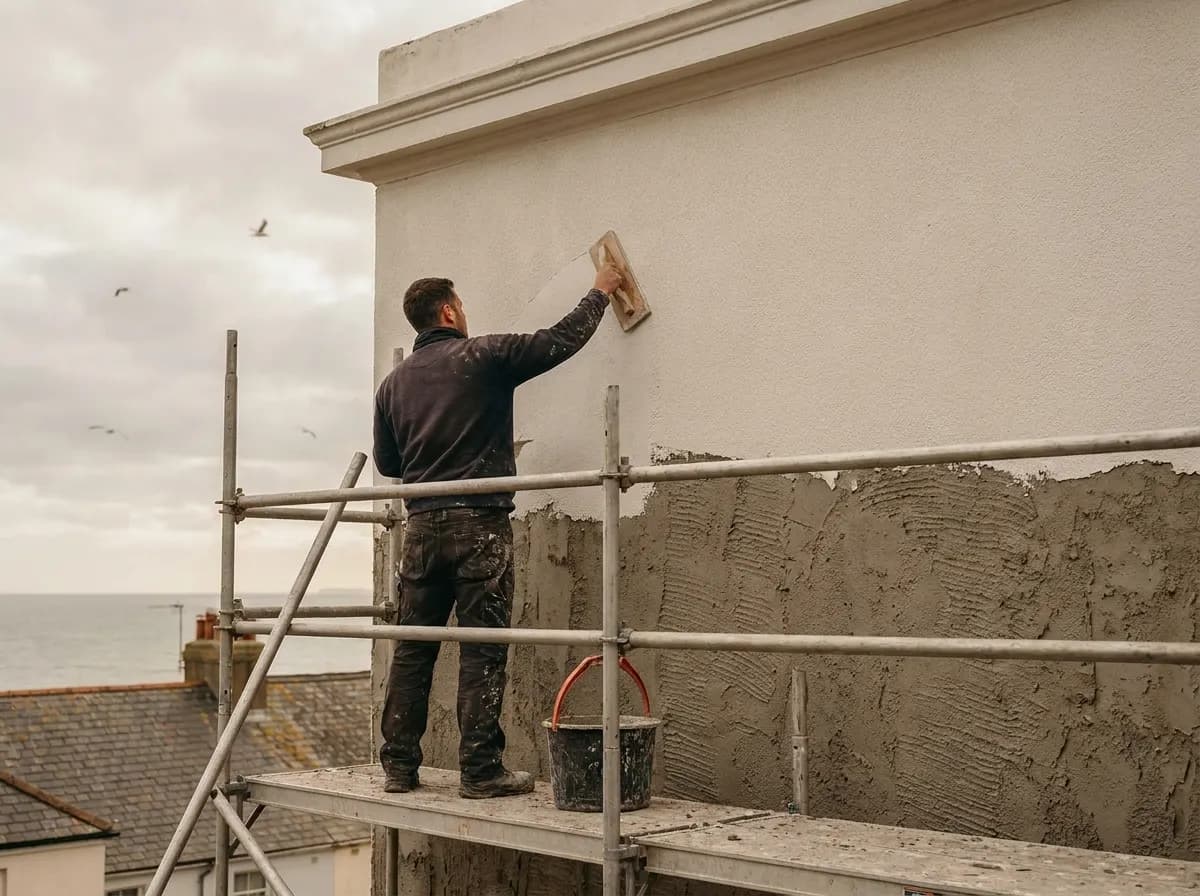
The Brighton Plasterer renders across Portslade and BN41, taking in Mile Oak, Fishersgate, Portslade Village and Southwick. Most of the estate housing is cavity blockwork that suits monocouche, while the exposed gable ends and harbour-side elevations need a tougher specification and far more attention to the base and the joints.
Rendering in Portslade, and what is different about it
Gable ends are where most Portslade render work starts. On the estates climbing up from the harbour, a great many houses present a blank two-storey flank straight into the prevailing wind, with no windows, no overhang worth speaking of and nothing in front of it. That one wall takes more weather than the rest of the house put together, and it is usually the wall people ring about.
The backgrounds around here are refreshingly predictable. Mile Oak, Victoria Road and the post-war streets behind Fishersgate are cavity construction with blockwork outer leaves, sometimes already carrying a thin coat and sometimes bare and painted. Down in the village the picture changes completely, with flint and lime-mortared rubble that has to be treated as the historic fabric it is. Along the harbour road there is a third category again, single-storey industrial and light commercial units in rendered blockwork where large uninterrupted panels run for tens of metres with no openings to relieve them.
Blockwork is a good friend to a renderer, which makes monocouche the natural choice on most of the estate housing. It goes on thick in one application, is coloured through so it never wants painting, and takes a scraped finish that hides the small imperfections a flat modern face would show. On an exposed gable a silicone finish over a reinforced base is worth the extra, since it stays flexible and sheds driving rain quickly. In the village neither belongs anywhere near a flint wall, and the answer is a lime render or leaving the stone alone.
A gable is unforgiving, so its details get more thought than the rest of the job. Render is taken cleanly up under the verge with a bead rather than butted into mortar that will crack, a bellcast throws water off well above the ground, and any long unbroken run gets a movement joint before the wall decides where to make one itself. On the harbour units the same principle applies at a bigger scale: panels of wall running twenty or thirty metres need joints planned into the setting out, because thermal movement across that length is real and it always wins.
Also covered from Portslade: Southwick, Mile Oak, Fishersgate, Hangleton. For the full picture of Portslade and every service there, see the Portslade page.
What Portslade needs watching for
Gable takes the weather
A blank flank facing the harbour gets the reinforced base coat and the tougher finish, even when the rest of the house is happily carrying a standard monocouche.
Long panels need joints
Industrial elevations along the harbour road run for tens of metres without an opening, so joints are set out at the start instead of appearing as cracks later.
Village flint left breathable
Up in the old village a lime render or no render at all is the right answer, because a cement coat on rubble and flint traps moisture inside the wall.
How the job runs
Step by step in Portslade
The order below is how a rendering job actually runs on the kind of property Portslade is made of. For the full method and the materials behind it, see the rendering page.
01Flank and background read
The gable and the main elevations are assessed separately, since one wall on an estate house here often needs a different build-up to the three sheltered behind it.
02Scaffold up, beads fixed
Scaffold is arranged for the full height of the flank, then verge, angle and bellcast beads are set so the coat has a clean edge everywhere it terminates.
03Base coat, joints formed
The base coat is applied, reinforced where the exposure demands it, and movement joints are formed into long runs before it is left to cure at its own pace.
04Monocouche laid and scraped
The through-coloured coat is applied at full thickness, allowed to firm, then scraped back to an even texture, which is the stage that decides how the wall reads.
Straight answers
When it is not the right answer here
- A flint village wall bedded in lime should never be given a cement render.
- Render will not cure a gable that is wet because its cavity is bridged.
- If a harbour unit is cracking structurally, that is a builder's job before it is a renderer's.
Also done in Portslade
Rendering, Portslade
Rendering in Portslade, questions answered
What people in Portslade ask before booking rendering, answered properly rather than in one line.
Why does the gable end of my Portslade house get damp inside?
Because it takes the weather nobody else does. A blank flank facing the harbour has no overhang and no openings, so wind-driven rain sits on it for hours. Bridged cavity ties, a failed verge or a cracked coat are the usual routes in.
Is monocouche a good choice for a Mile Oak house?
It is a strong fit. The blockwork up there gives a stable, absorbent background, and monocouche goes on in a single coloured application that never needs painting. On the most exposed flank a silicone finish over a reinforced base is the better call.
What is a scraped finish and will it show marks?
A scraped finish is achieved by letting the coat firm and then dragging the surface back to expose the aggregate, giving an even, slightly open texture. It hides minor variation well and does not show handling marks the way a flat, closed face does.
Do you render industrial units on the harbour road?
Yes. Rendered blockwork elevations on the estates are regular work, including patch repairs to damaged panels. Long runs get their movement joints set out first, and James can phase the job around a unit that is still trading.
Can you render just one wall rather than the whole house?
Yes, and on an estate house it is often the sensible thing to do. The flank is the wall taking the punishment, so treating it alone is a legitimate answer as long as the edges where it meets the other elevations are stopped properly.
How often should a monocouche wall in Portslade be cleaned?
Every few years is usually enough near the harbour, sooner on a shaded elevation. Salt deposits and organic growth come off with low pressure and a suitable cleaner, and getting to them early keeps the colour looking even.
Does re-rendering a whole house need building regulations approval?
It can. Renovating a large proportion of an external wall may be treated as work to a controlled thermal element, which brings building regulations into play. It is worth checking with the local authority, and James will raise it if he thinks it applies.
How do you price a render job in Portslade?
From a look at the actual elevations, not from a rate per square metre over the phone. The gable, the background, the access and the amount of beading all move the figure. Ring or WhatsApp 07999 837148 to arrange a visit.
Rendering in Portslade? Call James
Free quotes across Portslade and Southwick, Mile Oak, with a written price before anything starts.