
East Sussex, BN1, BN2
Brighton rendering, and the walls in this city that should not be rendered
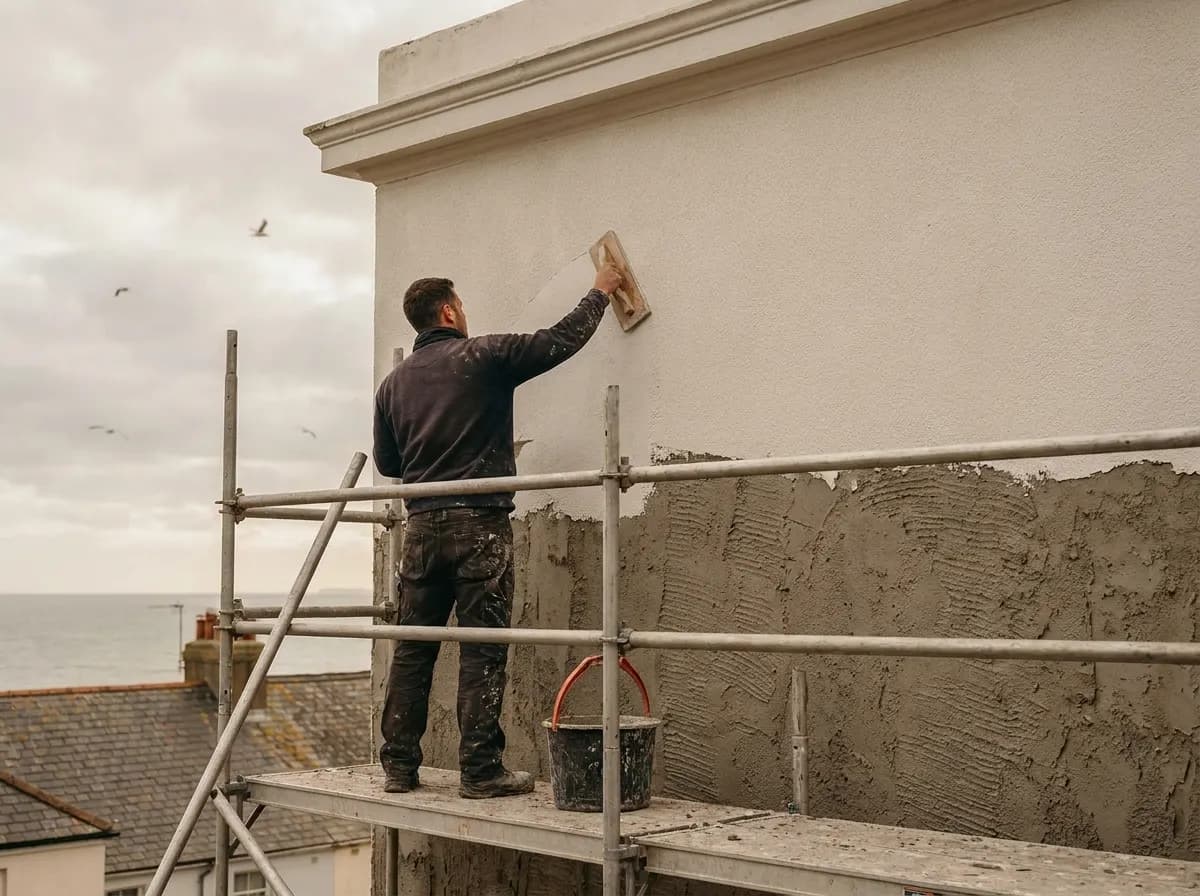
The Brighton Plasterer carries out exterior rendering across Brighton, in BN1 and BN2. James checks the wall build first, because much of the older city is bungaroosh or soft brick that needs a breathable coat, while blockwork and later extensions suit monocouche or a through-coloured silicone render.
Rendering in Brighton, and what is different about it
Most rendering enquiries in Brighton start with a look at the building rather than a price. The city has more solid, soft-bound walls than almost anywhere on this coast, so the first question is whether a render belongs on that elevation at all. Where it does, usually a rear extension, a blockwork flank or a later addition, it can be a very good answer.
Central Brighton is full of walls that were never meant to carry a hard skin. Bungaroosh, soft handmade brick and lime-bedded flint all move moisture through themselves, and a dense cement coat over the top gives that moisture nowhere to leave. What follows is predictable: the render sounds hollow where it has debonded, salts push through the face, and the wall behind stays wetter than it was before anyone touched it. On those elevations James either declines the render or specifies a lime one, and he will say which before you have paid for anything.
Plenty of the city is a straightforward render job, though. The interwar and post-war stock out at Patcham, Withdean, Moulsecoomb and Woodingdean is cavity blockwork, and so is nearly every rear extension built in the last forty years. Blockwork takes a monocouche or a silicone system well, holds a mechanical key and moves very little. Colour matters more than people expect here, because the light in this city is bright and hard off the sea, and a shade chosen from a chart indoors can read very differently on a south-facing flank wall in July.
The details that decide how long a Brighton render lasts are mostly at the top and the bottom. A bellcast bead set clear of the ground throws water off the face instead of letting it run back under the coat. Stop beads at every opening give a clean edge that will not chip. Where a rendered extension meets the original brick, a movement joint stops one structure dragging the other. Add the local complication, which is that half the streets are permit controlled and a scaffold on a narrow terrace needs a licence, and the planning matters as much as the mixing.
Also covered from Brighton: Rottingdean, Saltdean, Ovingdean, Withdean, Patcham. For the full picture of Brighton and every service there, see the Brighton page.
What Brighton needs watching for
Render or leave alone
On a bungaroosh or soft brick front elevation the honest recommendation is often no render at all, and James would rather lose that job than cause a damp problem.
Colour read outdoors
Sample panels go up on the actual wall and get looked at in daylight, because hard coastal light makes a chart colour behave differently once it is on the building.
Permits and scaffold licences
Most central streets are permit controlled and a pavement scaffold needs a licence from the council, so both are arranged and priced before the first lift goes up.
Rendering nearby
How the job runs
Step by step in Brighton
The order below is how a rendering job actually runs on the kind of property Brighton is made of. For the full method and the materials behind it, see the rendering page.
01Wall build identified
James taps the elevation, opens up a small area where needed and establishes whether he is looking at bungaroosh, solid brick, flint or cavity blockwork before any system is chosen.
02Scaffold and beads set
Scaffold is booked with the licence it needs on a terraced street, then bellcast, stop and angle beads are fixed level and true so the coat has something honest to work to.
03Base coat and cure
The scratch or base coat goes on, is keyed and then left to cure fully rather than being chased, because a top coat over green backing is the usual cause of early cracking.
04Top coat and finish
The finish coat is applied and textured to the agreed sample, the scaffold is struck, and any reveals, sills and downpipe fixings are made good before the site is cleared.
Straight answers
When it is not the right answer here
- A solid Brighton wall that has always breathed should not be sealed with a dense cement render.
- If a wall is wet from a failed gutter or a bridged ground level, fix that first.
- On a listed front elevation, stucco repair and consent come before any thought of a modern system.
Also done in Brighton
Rendering, Brighton
Rendering in Brighton, questions answered
What people in Brighton ask before booking rendering, answered properly rather than in one line.
Should I render the front of a Regency house in Brighton?
Usually not. A Regency frontage here is likely to be bungaroosh or soft brick behind lime stucco, and a modern coat over that traps moisture in a wall built to release it. Where the facade needs work, stucco repair in a lime material is the right answer.
Which render suits a rear extension in Brighton?
Most extensions built in recent decades are cavity blockwork, which is an excellent background. Monocouche gives a coloured, scraped face in one application, and a through-coloured silicone over a reinforced base suits an exposed wall or an owner who never wants to repaint.
How long does exterior render last in Brighton?
A correctly specified system on a sound background, detailed properly at the base and the openings, gives many years of service with only an occasional wash down. What shortens that life is nearly always a detail rather than the product itself.
Do I need planning permission to render a house in Brighton?
For most houses a like-for-like re-render is unlikely to need permission, but this city has a great many conservation areas and listed buildings where the rules differ and consent can apply. James will raise it if he thinks your property falls into that group.
Can you render a flank wall on a narrow Brighton street?
Yes, and it comes up constantly on the terraced streets. A scaffold standing on the pavement needs a licence and trade parking usually has to be arranged, so both are sorted and priced before a start date is agreed.
Can existing render on a Brighton house be patched instead of replaced?
Sometimes. Where the failure is confined to one area and the rest of the coat rings solid when tapped, a keyed and blended patch is a sensible repair. Once hollow areas are spread across the elevation, patching becomes a rolling cost.
Does a rendered wall in Brighton need cleaning?
A gentle wash down every few years keeps a through-coloured finish looking as it should, especially on a shaded elevation. Use low pressure and a suitable cleaner rather than a lance at full power, which can drive water into the coat.
How do I get a rendering quote in Brighton?
Ring or message James on 07999 837148, or use the form on this site. For render work he will look at the elevation and identify the background before giving a figure, and both the visit and the written price are free.
Rendering in Brighton? Call James
Free quotes across Brighton and Rottingdean, Saltdean, with a written price before anything starts.