
East Sussex, BN7
Lewes render in lime, and knowing what sits behind the coat
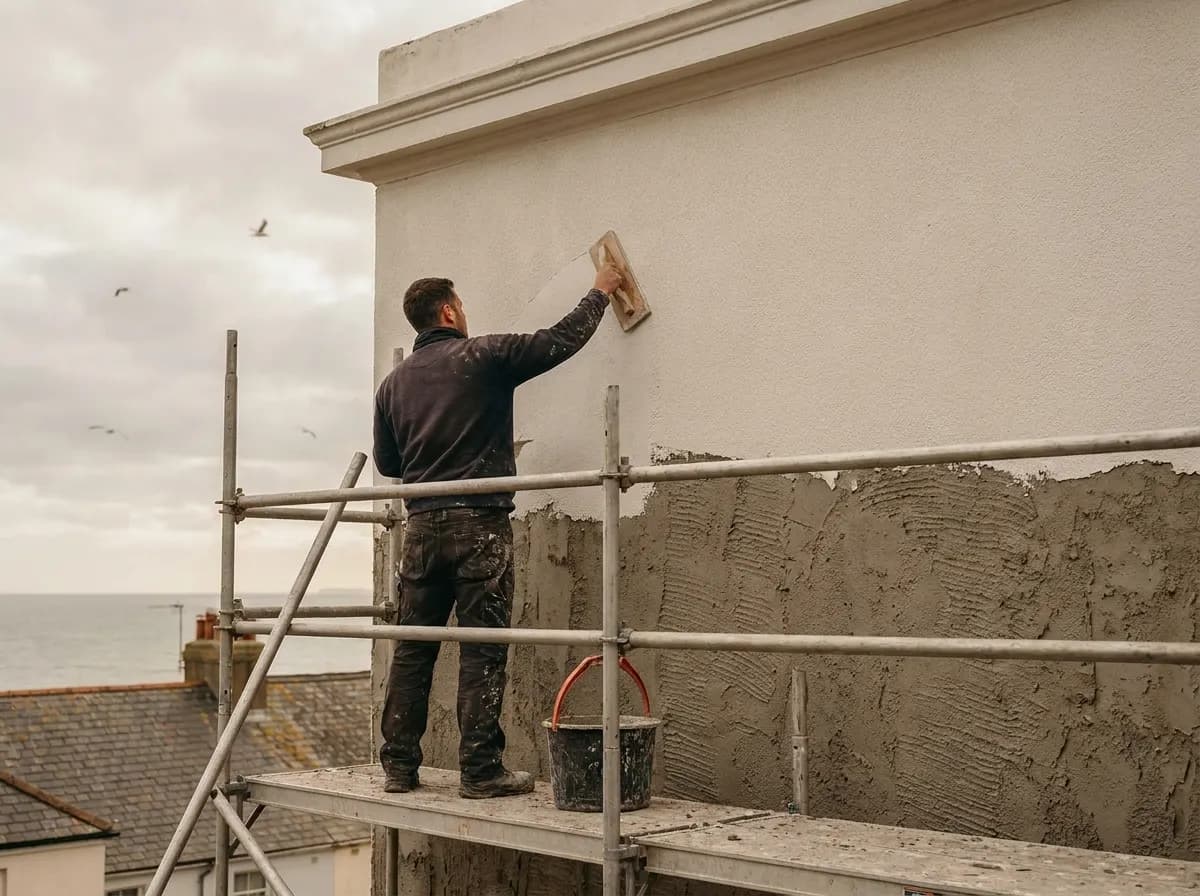
The Brighton Plasterer renders in Lewes and BN7 using lime where the building needs it. Much of the town is listed or in a conservation area, built of flint, soft brick or timber frame, so James specifies a breathable lime render there and keeps modern systems for the later estates.
Rendering in Lewes, and what is different about it
Rendering in Lewes is a materials decision before it is a building decision. The old town is flint, soft handmade brick, timber frame and mathematical tiles, and every one of those wants a coat that can pass moisture rather than hold it. Get that wrong and the damage lands on the fabric behind, which in this town is often protected and always expensive to put right.
Exposure here is nothing like the coast, and that changes the failure mode. The town sits in the Ouse gap, so instead of constant salt it gets funnelled westerly rain up the valley, long damp spells and hard frosts on north elevations that never see winter sun. Frost is the quiet killer of render inland. Water sitting in a saturated coat freezes, expands and pushes the face off in flakes, which is exactly why a wall that can dry between showers outlasts one that has been sealed up tight.
On historic fabric the answer is a lime render, built up in coats over a well-wetted background, the first coat haired where the substrate calls for it, each coat weaker than the one beneath so any movement is taken by the surface rather than the wall. It is slower work. Lime sets by taking in carbon dioxide over weeks, needs protecting from sun, wind and frost while it does, and cannot be rushed to suit a diary. Out on the Nevill, Landport and the newer estates none of that applies, and a monocouche or a silicone system over blockwork is perfectly sensible.
Detailing a lime job in Lewes is about shedding water without sealing anything. That means a generous overhang kept clear, a formed drip or a bell at the base so the coat stops above a flint plinth rather than running into wet ground, and junctions worked to the building rather than beads driven through it. Consent is part of the detailing too. Altering the external finish of a listed building, or one inside the conservation area, can need permission from the district council, and James raises that before a start date is discussed rather than after the scaffold is standing.
Also covered from Lewes: Cliffe, Southover, Kingston near Lewes, Ringmer, Barcombe. For the full picture of Lewes and every service there, see the Lewes page.
What Lewes needs watching for
Frost and drying time
A lime render laid too late in the year can be caught by frost before it has set, so autumn and winter work is planned around the forecast or held over.
Mathematical tiles under render
An elevation that looks like brick may be hung tiles, and finding that out before quoting changes the whole approach to fixing and finishing it.
Plinth and ground level
Render is stopped clear above a flint or brick plinth, because a coat carried down into damp ground gives water a direct path into the wall.
How the job runs
Step by step in Lewes
The order below is how a rendering job actually runs on the kind of property Lewes is made of. For the full method and the materials behind it, see the rendering page.
01Fabric and consent checked
The background is identified, the conservation or listed status is checked, and any permission likely to be needed is flagged before a start date goes in the diary.
02Access and set out
Scaffold is arranged with protection to keep sun, wind and rain off the new work, and the lines, stops and plinth level are set out on the wall itself.
03Haired base coat
The wetted background takes a lime base coat, keyed and then cured slowly under cover, dampened as needed so it carbonates properly instead of drying out too fast.
04Finish coat, slow cure
The finishing coat is applied weaker than the one below it and left to cure over weeks, which is longer than a modern system and is the price of doing it correctly.
Straight answers
When it is not the right answer here
- A cement render on a flint or timber-framed Lewes wall causes damage that shows up years later.
- If a listed elevation needs consent, no work starts until that has been granted.
- A wall soaked by a leaking downpipe wants the downpipe fixed, not a new coat.
Rendering, Lewes
Rendering in Lewes, questions answered
What people in Lewes ask before booking rendering, answered properly rather than in one line.
What kind of render is right for a flint wall in Lewes?
A lime render, applied in coats over a dampened background and cured slowly. Flint bedded in lime mortar takes up and releases moisture constantly, and a cement coat over it holds that water inside the wall where it does real harm.
Why does lime render take so long to cure?
Lime sets by taking carbon dioxide back out of the air, which is a chemical process measured in weeks rather than days. It also has to be protected from sun, wind and frost while it happens, so the programme is dictated by the material and the weather.
Do I need consent to change the render on a Lewes house?
Possibly. Altering the external finish of a listed building, or of one inside a conservation area, can need permission from Lewes District Council. James will say when he thinks it applies so you can check before anything is booked.
Can you render in winter in Lewes?
Modern systems can go on in cold weather within their stated limits, but a lime render caught by frost before it has set will be ruined. Work of that kind is either planned for the warmer months or protected and heavily monitored.
Will a lime render need painting?
It does not have to be. Lime can be finished and left, or given a limewash or a mineral paint that lets the wall keep breathing. What it must never have is a modern plastic-based masonry paint sealing the surface.
How long does a lime render last before it needs attention?
Properly built up and detailed, lime render on a historic wall lasts a very long time and tends to weather gradually rather than fail suddenly. Small areas can be cut out and made good without disturbing the rest of the elevation.
Can you render a modern house on the Nevill?
Yes, and it is a much simpler job. Post-war and later housing there is cavity blockwork, so monocouche and through-coloured silicone are both open to you and the historic building constraints of the old town do not apply.
What do you need to see before quoting a render job in Lewes?
The elevation itself, the base of the wall and the plinth, and anything that shows what the building is made of. Ring or WhatsApp 07999 837148, and expect James to ask about listed status before he talks about materials.
Rendering in Lewes? Call James
Free quotes across Lewes and Cliffe, Southover, with a written price before anything starts.