
West Sussex, BN11 to BN14
Worthing re-render decisions, from hollow roughcast to bay fronts
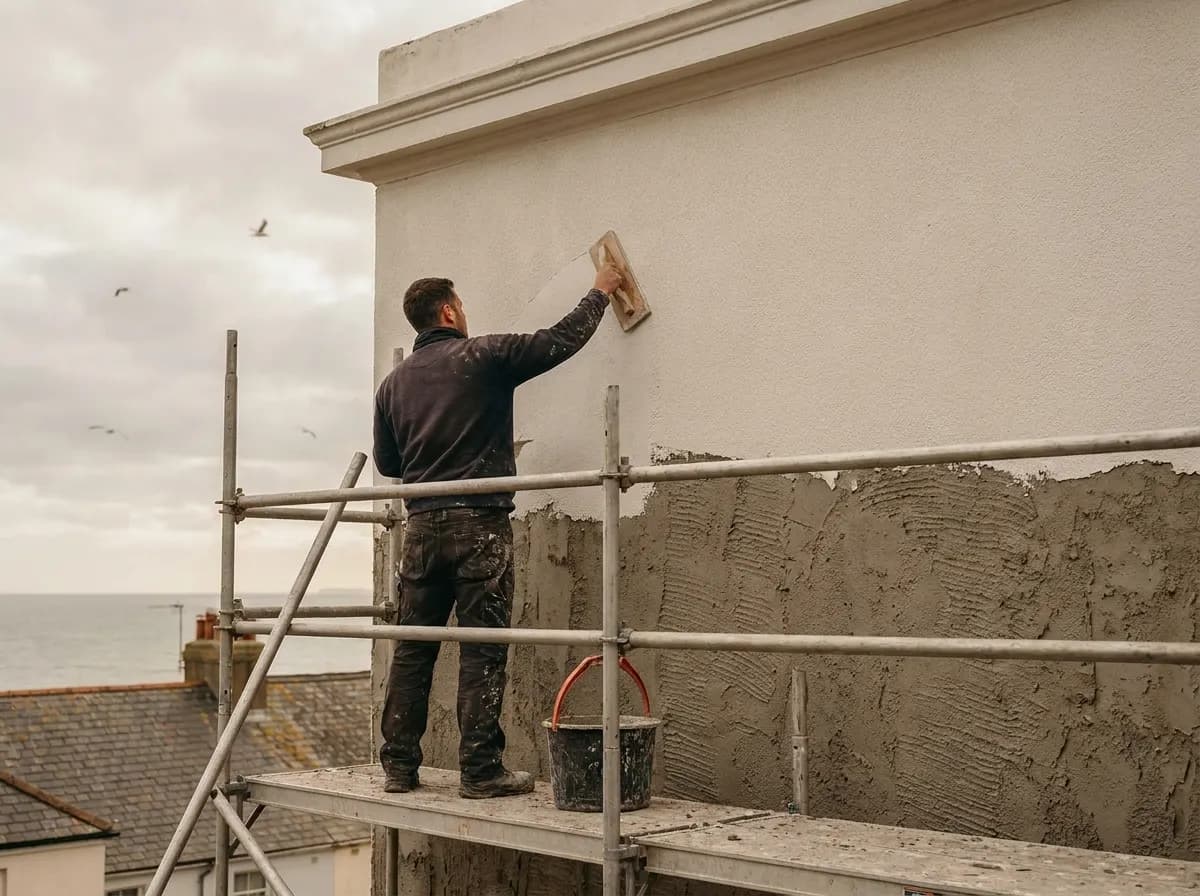
The Brighton Plasterer re-renders houses across Worthing, covering BN11 to BN14. James surveys the existing coat by tapping the whole elevation for hollow areas, then decides between patching and a full strip, and specifies a monocouche or through-coloured silicone system to suit the background underneath.
Rendering in Worthing, and what is different about it
Almost every render job in Worthing is a second render, not a first. The interwar streets went up already finished in roughcast, so the question is rarely which system to choose and nearly always how much of the old coat is still holding on. That answer comes from a hammer handle and a couple of hours, not from a look at the front from the pavement.
The building stock here is unusually consistent, which helps. Street after street of 1930s semis and short terraces, cavity brick behind, finished in roughcast with rendered bay fronts and rendered chimney stacks. The failures are consistent too. Bays go first because they have three exposed faces, a shallow roof above and a joint at every return. Stacks come next, standing clear of the roof with weather on all sides and nothing sheltering them. The main wall is often still sound long after both of those have gone, which is why a blanket price per square metre tells you very little.
Once the survey is done the choice is straightforward. Where the old roughcast is sound and well bonded over most of the elevation, it can be prepared and taken as a background, with a mesh-reinforced base coat carrying the new finish across the variations. Where a third or more sounds hollow, taking it all off is quicker and cheaper than chasing failures for the next decade. On this open, south-facing stretch the finish coat is usually a through-coloured silicone, chosen because salt and driving rain are constant and nobody wants to be repainting a two-storey elevation on a ladder.
The parts of a job here that decide its life are the ones people never look at. A bay needs a proper stop bead where render meets the roof upstand, and a drip formed under every sill so water leaves the face instead of tracking back underneath. A stack wants render taken down cleanly to a flashing, not feathered onto lead. The party line between two halves of a semi needs a straight, deliberate stop, because a neighbour may render their half in ten years and a ragged edge will look wrong forever.
Also covered from Worthing: Lancing, Goring-by-Sea, Durrington, Sompting, Findon. For the full picture of Worthing and every service there, see the Worthing page.
What Worthing needs watching for
Hollow areas mapped first
The whole elevation gets tapped and marked before a price is given, since the proportion of the old coat that has debonded is what decides patch or full strip.
Bays and stacks priced
Bay fronts and chimney stacks carry most of the exposure on a 1930s semi, so they take more time and more beads than the flat run of wall between them.
A tidy party line
Where only one half of a pair is being done, the stop at the party line is set out square and clean so the elevation still reads properly from the street.
How the job runs
Step by step in Worthing
The order below is how a rendering job actually runs on the kind of property Worthing is made of. For the full method and the materials behind it, see the rendering page.
01Survey and mark up
Every square metre of the existing coat is sounded and the hollow areas are marked, which turns the patch or strip question into a measurement instead of an opinion.
02Scaffold and bead run
Scaffold covers the bay and the stack, not just the flat wall, and the bead run is set out so reveals, returns and the party line are square before mixing starts.
03Base coat and mesh
A reinforced base coat is applied over the prepared background, meshed across any change of substrate, and left to cure before anyone thinks about the finish.
04Finish and weather details
The through-coloured coat is applied and floated to the sample, then sill drips, the stack flashing junction and the bay upstand are finished so water always leaves the wall.
Straight answers
When it is not the right answer here
- If the wall behind the roughcast is wet from a failed gutter, sort the gutter first.
- A render will not cure condensation inside a cold, unventilated bedroom.
- Where only a bay has failed, a full elevation re-render is money spent for no gain.
Also done in Worthing
Rendering, Worthing
Rendering in Worthing, questions answered
What people in Worthing ask before booking rendering, answered properly rather than in one line.
How do you tell if my Worthing roughcast is still bonded?
By sounding it. The elevation is tapped systematically and a hollow area answers with a completely different note to one still stuck to the wall. Those areas get marked up so you can see the proportion for yourself before deciding.
Can you render over old roughcast instead of removing it?
Yes, provided the old coat is genuinely sound across most of the wall. It is prepared, keyed and taken as a background with a mesh-reinforced base coat over it. Where large hollow areas exist, that shortcut simply passes the failure into the new work.
Why does the render fail on my bay window first?
A bay presents three faces to the weather, has a shallow roof sitting on top of it and carries a joint at every return, so it collects far more water than the flat wall beside it. It is the first thing James checks on a 1930s semi.
Should the chimney stack be rendered at the same time?
Usually yes, because the scaffold is already there and a stack takes weather on every side. Doing it later means paying for access twice. The render is stopped cleanly at the flashing rather than run over the lead.
How long should a silicone render last in Worthing?
Well specified and properly detailed, a through-coloured silicone coat should give many years on this coast with no repainting and only periodic washing. Failure here tends to trace back to the base detail or the background, not the material.
What happens if my neighbour does not want their half rendered?
The job simply stops at the party line with a deliberate, square edge rather than a feathered one. It is done that way so the two halves still line up visually and so a future render next door can butt cleanly against yours.
Do you need access to next door to scaffold my flank wall?
Often yes on a semi or an end terrace. James will tell you at the quoting stage what access is needed so you can speak to the neighbour early, and the scaffold is planned to sit within the agreed footprint.
What will you need to see before pricing a Worthing re-render?
The whole elevation, including the bay, the stack and the base of the wall at ground level, plus a look at the gutters and downpipes. Ring or WhatsApp 07999 837148 to arrange it, and the visit and written price cost nothing.
Rendering in Worthing? Call James
Free quotes across Worthing and Lancing, Goring-by-Sea, with a written price before anything starts.